

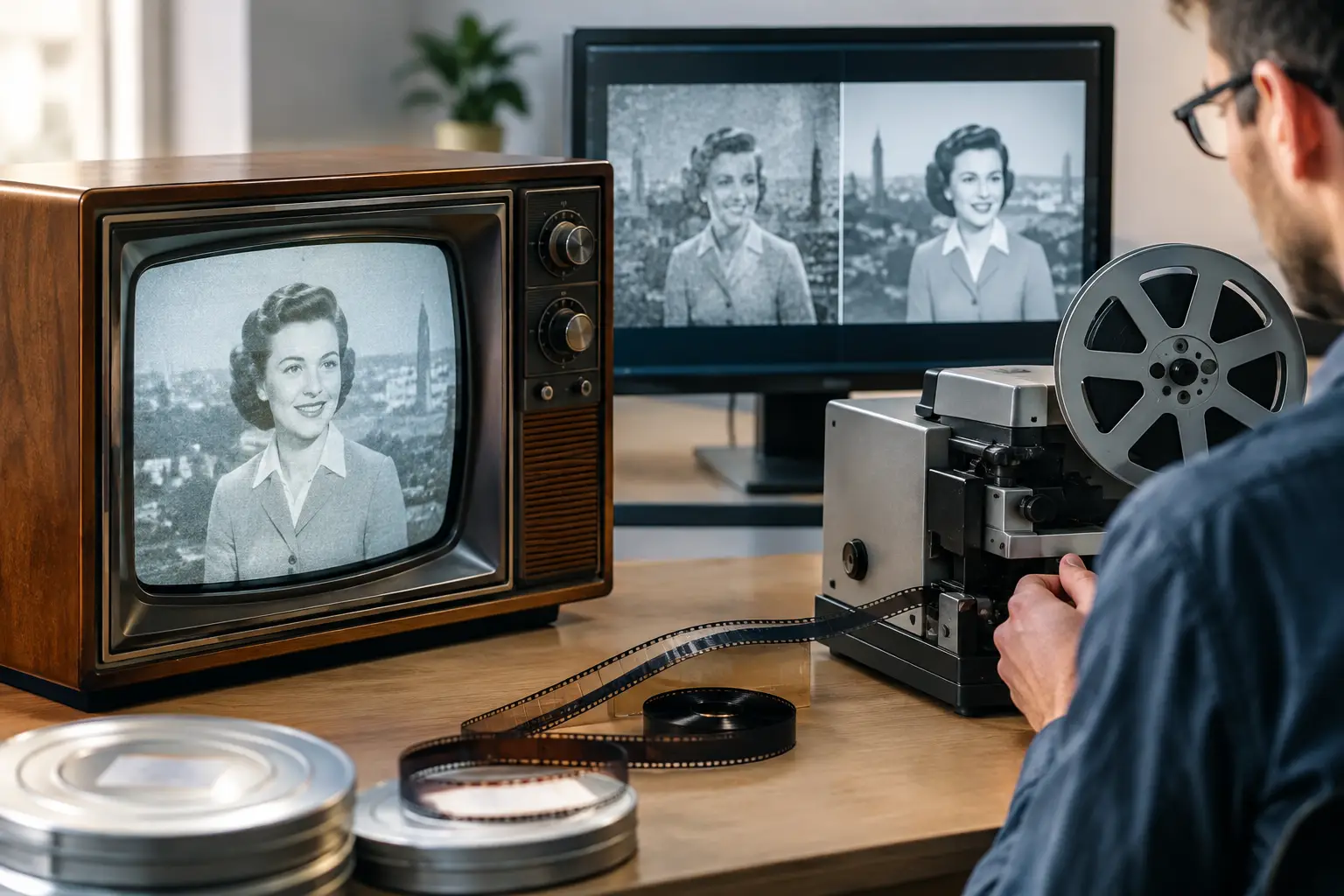
A surprising amount of early television survives because someone pointed a motion-picture camera at a glowing TV monitor. That is the humble, vital origin of television kinescope restoration: rescuing programs that were once considered too immediate, too disposable, or simply too ordinary to preserve. The result is more than a cleaner image. It is a second chance to see television finding its voice in real time.
Before videotape became practical, live broadcasts disappeared the moment they aired unless they were captured on film. Variety hours, network dramas, comedy routines, news specials, children’s programming, and early celebrity appearances could all be recorded through a kinescope process. The images were often soft, flickering, and full of visible scan lines. Yet for viewers and collectors, those marks are part of the artifact. They prove that a performance crossed from a studio monitor onto film and made it through the decades.
What a Kinescope Actually Preserves
A kinescope is not a television episode filmed in the usual studio sense. It is a film recording of a television picture, traditionally made by synchronizing a film camera with the cathode-ray tube monitor displaying the live broadcast. The process gave broadcasters a way to send programs to other time zones, retain a record for sponsors, or preserve a show for later rebroadcast.
That difference matters when watching restored material. A kinescope may show curved screen edges, frame roll, uneven brightness, scan-line texture, or motion that feels slightly strange. It may also include the occasional cue, splice, or abrupt reel change. These are not necessarily restoration failures. They are traces of early television technology, captured at a moment when the medium was still inventing its own rules.
For classic entertainment fans, kinescopes can contain performances unavailable anywhere else. A familiar star may appear years before a famous film role. A comedy team may test material in front of a live audience. A western, musical, or serial-style adventure may reveal how television borrowed from radio, vaudeville, and Hollywood while developing a faster, more intimate rhythm.
Why Television Kinescope Restoration Matters
Early TV was built around live transmission. That made it exciting, but fragile. Film could be stored, copied, or rediscovered in a vault. A live broadcast without a recording was gone. Even when a kinescope existed, it was often treated as a temporary business record rather than a cultural document.
Restoration gives those recordings a future. It can stabilize damaged film, reduce excessive dirt and scratches, correct density fluctuations, repair torn frames, and improve audio intelligibility. Careful work makes a program easier to watch without pretending it was produced with modern cameras or high-definition equipment.
The historical payoff is enormous. Kinescopes preserve early forms of television comedy, advertising, political communication, sports presentation, variety programming, and children’s entertainment. They also preserve the physical reality of live production: rushed scene changes, visible nerves, missed cues, applause that arrives at unexpected moments, and performers adapting before an audience.
That sense of risk is part of the attraction. A polished studio production can be timeless, but an early live kinescope can feel startlingly present. You are not only watching a show. You are watching people make television while the medium is still young.
The Restoration Challenge Is More Than Removing Scratches
A strong restoration starts with the best surviving source. Sometimes that is a fine-grain master positive. Sometimes it is a worn 16mm print made for regional distribution. In more difficult cases, the only available material may be a duplicate print with heavy damage, faded contrast, or missing sections. The source determines what is possible.
Film inspection comes first. Archivists and restoration specialists look for shrinkage, warping, perforation damage, brittle splices, mold, vinegar syndrome, and soundtrack wear. A fragile reel may need careful repair and cleaning before it can safely pass through a scanner. The goal is preservation before enhancement. If the film is unstable, no amount of digital work can substitute for proper handling.
Once scanned, the image can be stabilized frame by frame. Dirt removal, scratch reduction, flicker correction, and contrast balancing may make a dramatic difference. But the best results are restrained. Remove every bit of grain and the picture can become waxy or artificial. Push sharpening too far and halos appear around faces and sets. Force deep blacks into an underexposed kinescope and important details disappear into shadow.
Audio brings its own set of problems. Early television soundtracks may have hum, hiss, distortion, limited frequency range, or volume swings. Restoration can reduce distractions and clarify dialogue, but it cannot create sound that was never captured. A little room noise or broadcast roughness may be authentic to the program’s original character.
Authenticity Is Part of the Picture
There is no single correct look for every restored kinescope. Some viewers prefer a clean, steady presentation that feels more accessible on a large modern screen. Others want the original broadcast texture intact, including the slight flicker and monitor character that distinguish kinescope recordings from conventional film.
The most thoughtful approach respects both audiences. Correct damage that interrupts the program, such as severe jumps, tears, or audio dropouts. Preserve characteristics that explain how the recording was made. Restoration should help a viewer see the original performance more clearly, not turn a 1950s television document into something it never was.
Colorization and AI-assisted enhancement require even more care. They can be interesting interpretive tools, especially when clearly presented as alternate versions. Still, they are not replacements for a faithful black-and-white restoration. Color choices, reconstructed detail, and generated motion can introduce decisions that belong to the modern era rather than the original production.
What Viewers Can Look For in a Restored Kinescope
When a classic television program has been restored well, the improvements are often felt before they are noticed. Faces are easier to read. White shirts no longer bloom into a flat glare. Dark suits hold their shape. The soundtrack allows a punch line, a song lyric, or a dramatic pause to land as intended.
A few remaining imperfections do not mean the work was incomplete. If the source was filmed from a monitor, its inherent softness may remain. If a reel was cut long ago, a brief visual interruption may be impossible to hide. If the only surviving print is several generations away from the original broadcast, detail will be limited. These constraints are part of the survival story.
Viewers can also pay attention to the production itself. Look at the camera blocking, the live musical accompaniment, the speed of dialogue, and the way actors work around sets designed for small black-and-white screens. A kinescope often reveals a different kind of craft than later filmed television. It is closer to theater, closer to radio, and unmistakably its own thing.
A Living Archive of Screen History
For a collector, the appeal of restored early TV is easy to understand: these are rare pieces of entertainment history, often featuring recognizable stars and genres in forms that have been hard to find for decades. For a newer fan, they offer a direct route to the roots of the shows, characters, and production styles that followed.
Classic media deserves more than a dusty reputation. A restored kinescope can make an old broadcast feel immediate again – not because every trace of age has been erased, but because the performance can finally be seen and heard on its own terms. That is the pleasure of a preservation-minded catalog like HetFlix: giving overlooked screen history a place where it can be discovered, revisited, and enjoyed.
The next time a kinescope flickers onto the screen, give it a moment before judging its rough edges. Behind that glow may be a vanished live broadcast, a one-night performance, and a small surviving piece of television’s earliest memory.