

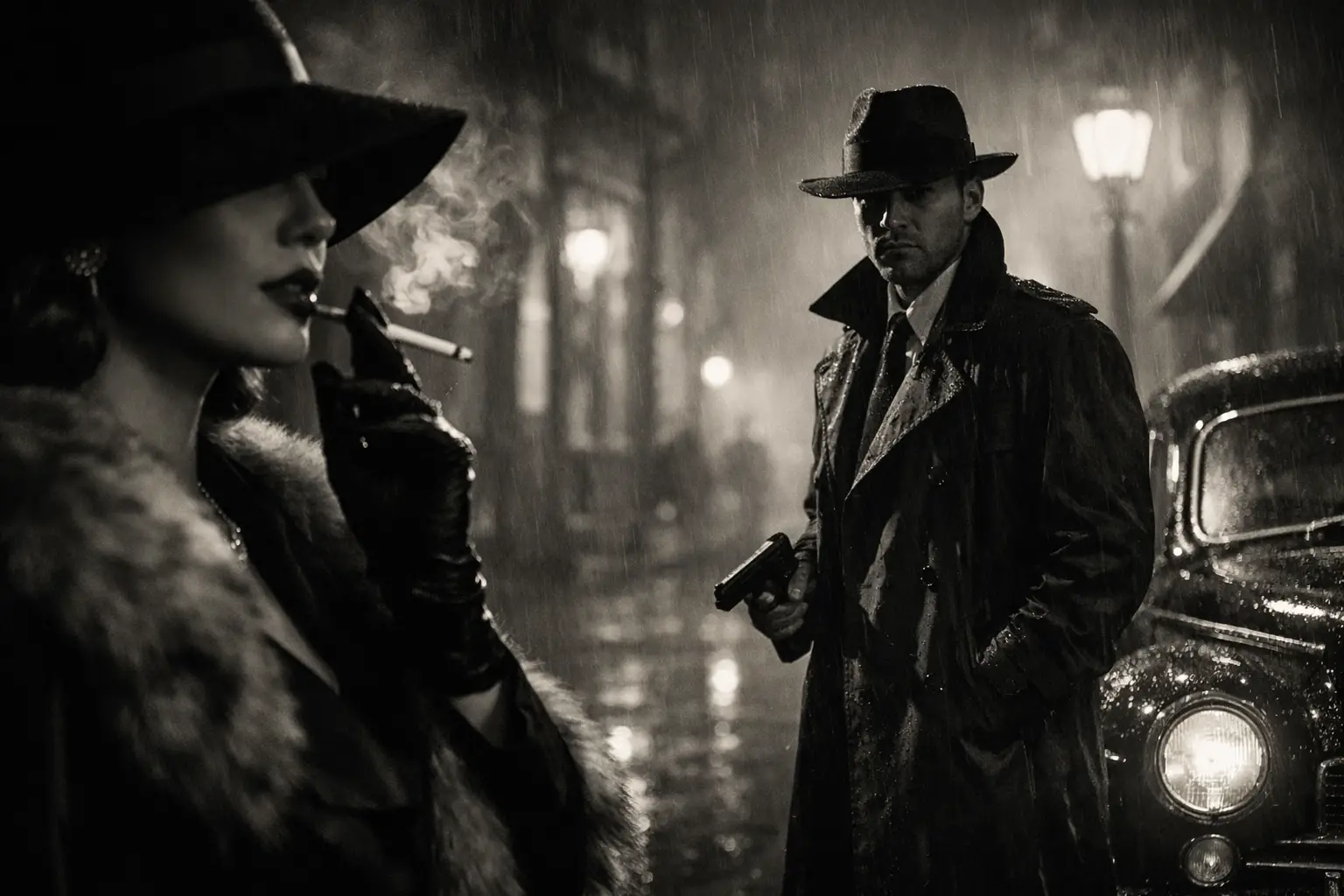
A detective stands beneath a flickering streetlamp. Rain shines on the pavement, a voice from the past tells us how everything went wrong, and the woman at the center of the case may know more than she admits. What makes film noir unique is not simply that it looks dark. It is that darkness becomes a way of seeing the world: suspicious, seductive, wounded, and impossible to fully trust.
For classic-film fans, noir offers a particular kind of pleasure. These films are compact, stylish, and packed with faces that seem made for black-and-white photography. A trench coat, a cigarette, a venetian-blind shadow, and one bad decision can create a whole universe of danger. Yet noir is more than a collection of familiar props. Its lasting power comes from the tension between glamorous surfaces and moral uncertainty.
What Makes Film Noir Unique? A Mood With Consequences
Film noir emerged most strongly in American crime films of the 1940s and 1950s, though its roots reach back to German Expressionism, hard-boiled fiction, and the anxiety of wartime and postwar life. The term itself means “black film,” but noir is better understood as a cycle, a style, and a mood than as one neat genre.
Westerns usually promise open spaces and a showdown. Musicals often move toward romance, spectacle, or reconciliation. Noir gives viewers a maze. Its characters may believe they are in control, but they are usually being watched, manipulated, trapped by a past mistake, or led toward an outcome they cannot escape.
That fatalistic pull is central. In a noir story, the crime is rarely just a puzzle waiting to be solved. It exposes rot beneath respectable life: corrupt businessmen, crooked cops, desperate veterans, lonely office workers, and seemingly ordinary people willing to cross a line. The mystery matters, but the pressure of the world matters more.
Shadows Are Part of the Story
Noir’s visual identity remains one of the first things viewers notice. Cinematographers use high-contrast lighting to split rooms, faces, and streets into areas of light and blackness. Blinds cast bars across a character’s face. Stairwells become traps. A small apartment can feel as threatening as a back alley.
This style was practical as well as expressive. Many noir pictures were made quickly and economically, often on modest budgets. Night shoots, limited sets, and dramatic lighting could make a small production look striking. But the technique did more than save money. It gave form to the characters’ divided lives. A man may insist he is innocent while half his face disappears into shadow. A woman may appear angelic in one scene and unreadable in the next.
The city is equally important. Noir cities are crowded but isolating. They are full of anonymous windows, cheap hotels, neon signs, late-night diners, police stations, and rooms where someone is always waiting for the phone to ring. Even when a story leaves the city for a beach, a desert road, or a suburban home, safety rarely follows.
The Noir Hero Is No Shining Knight
Classic noir often centers on a protagonist who is capable but compromised. He might be a private investigator, an insurance salesman, a drifter, a boxer, a doctor, or a veteran trying to start over. He can read a room, throw a punch, or deliver a memorable wisecrack. What he cannot do is remain untouched by the corruption around him.
That separates noir from a straightforward detective adventure. A traditional hero restores order. A noir hero may solve the case only after losing his money, his reputation, his lover, or his life. Sometimes he is guilty from the opening scene. Sometimes he is innocent, but his weakness, pride, desire, or fear makes him easy to exploit.
Humphrey Bogart’s tough private eyes helped define the public image of noir, yet the cycle is far broader than one actor or one kind of detective. In Double Indemnity, Fred MacMurray plays an ordinary salesman whose confidence leads him into murder. In Out of the Past, Robert Mitchum’s weary charm cannot free him from history. In The Killers, Burt Lancaster’s character seems to wait for doom rather than run from it. Each performance makes the noir hero feel human enough to understand and flawed enough to fear.
The Femme Fatale Is More Than a Label
Noir’s most famous female figure is the femme fatale: intelligent, alluring, secretive, and often dangerous. She has become an enduring pop-culture image, but the best noir women deserve more attention than the label allows.
A femme fatale may use her beauty and intelligence to survive in a world where power is largely controlled by men. She can be manipulative, certainly, but she is often responding to limited choices, financial dependence, abuse, or a society that expects her to remain decorative and obedient. Barbara Stanwyck in Double Indemnity and Jane Greer in Out of the Past are unforgettable because their characters project control while revealing flashes of vulnerability and calculation.
Noir also gives us women who are not femme fatales at all: secretaries who see the truth, wives trapped in unhappy marriages, nightclub singers, and investigators with their own agendas. The films can reflect the gender assumptions of their era, and some portrayals are narrow or harsh. That is part of the historical context worth recognizing. At their strongest, however, noir women complicate the story rather than merely decorating it.
Dialogue That Cuts Through the Smoke
Noir dialogue is lean, pointed, and often funny in a bleak way. Characters do not always say what they mean. A compliment can be a threat. A joke can conceal fear. A detective’s hard-edged narration may sound confident even as the images reveal that he has already lost control.
This verbal style comes from the hard-boiled crime fiction of writers such as Dashiell Hammett, Raymond Chandler, and James M. Cain. Their influence helped create a world in which people speak with rhythm and suspicion. The lines are memorable not because everyone talks like that in real life, but because the dialogue makes every exchange feel like a contest.
Voice-over narration adds another layer. When a character tells the story after the fact, viewers may sense disaster before they know its details. The narrator is not always reliable, and that uncertainty is pure noir. You are hearing a confession, a rationalization, or perhaps one final attempt to make sense of a terrible choice.
Noir Is a Feeling, Not a Locked Box
One reason noir remains exciting to collect and revisit is that its boundaries are flexible. Some noirs are detective stories, while others are domestic nightmares, heist pictures, boxing dramas, wartime thrillers, or tales of mistaken identity. The Big Sleep is built around private-eye investigation. Mildred Pierce mixes family melodrama with murder. Detour turns a cheap road trip into a nightmare of chance and guilt.
That flexibility creates lively debate among fans. Is every black-and-white crime movie noir? No. Does a color film qualify? It can. Later films such as Chinatown and Body Heat borrow noir’s visual language, cynical outlook, and morally tangled characters, which is why they are often called neo-noir. The look helps, but the deeper test is whether the story makes viewers feel that decency, desire, and danger are knotted together.
Why Film Noir Still Feels Immediate
Modern audiences recognize noir because its fears have not disappeared. People still worry about institutions that hide the truth, jobs that offer little security, relationships built on secrets, and the cost of one irreversible decision. Noir turns those anxieties into entertainment with style: a saxophone on the soundtrack, headlights cutting through fog, an elevator door closing at the wrong moment.
The films also reward close viewing. Watch how a mirror doubles a character, how a doorway frames an escape route, or how a supposedly casual conversation shifts after one revealing glance. Restored presentations can make those details especially vivid, bringing back texture in the night streets and delicate shades of gray that old television broadcasts often buried.
For viewers building a classic-film watchlist, start with a mix of landmarks and surprises. Pair the polished menace of Laura with the feverish desperation of Detour. Follow The Maltese Falcon with The Big Heat. You will see that noir can be elegant, brutal, romantic, strange, or darkly comic without losing its identity. HetFlix-style classic libraries make that kind of discovery feel less like homework and more like finding a forbidden late-night broadcast.
The next time a noir opens on a shadowed room and a man with nowhere good to go, watch the light as closely as the plot. Somewhere in those black spaces, the film is already telling you the truth.