
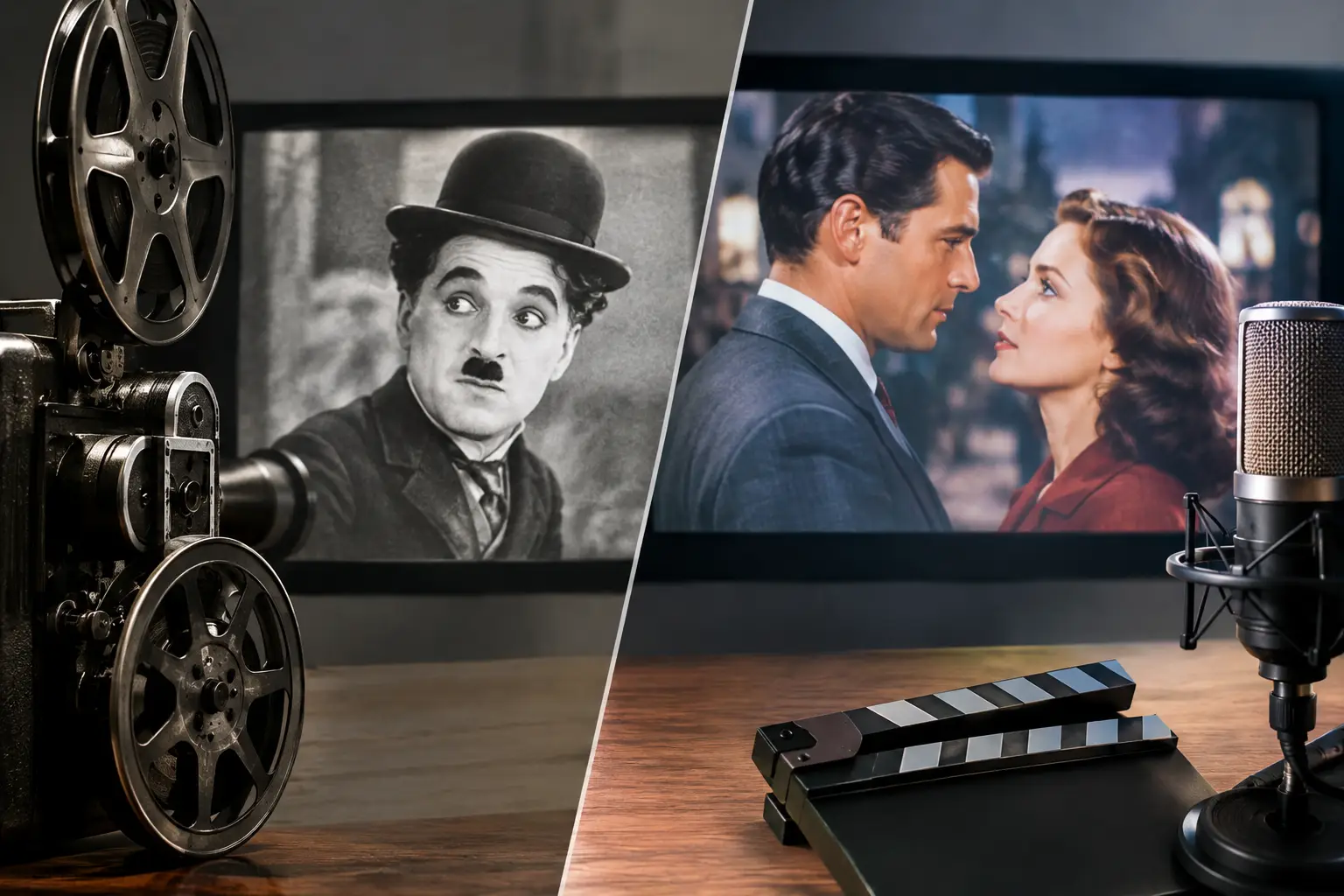
A face fills the frame. A villain twirls his mustache. A heroine reads the danger in a single glance while the orchestra races beneath the action. The debate over silent movies versus talkies is not simply about whether films had dialogue. It is about two distinct kinds of movie magic, each built around a different relationship between image, sound, performer, and audience.
Silent cinema could make a chase, a romance, or a pie fight feel instantly legible across borders. Talkies brought voices, songs, accents, and a new kind of intimacy. Neither era is merely a stepping stone to the other. For classic-film fans, they are connected chapters in a larger story – and both are full of treasures worth bringing back to the screen.
Silent Movies Versus Talkies: The Essential Difference
Silent films were rarely truly silent. In theaters, a pianist, organist, or full orchestra supplied music and sound effects in real time. Major productions sometimes traveled with elaborate musical scores, while neighborhood venues relied on a local musician who knew exactly when to underline a kiss, a punch, or a last-minute rescue.
What silent films did not have was synchronized spoken dialogue recorded with the picture. Instead, filmmakers used intertitles for key lines, narration, and dramatic information. The rest had to come through framing, gestures, editing, costumes, and the extraordinary expressiveness of the actors.
Talkies changed that equation after synchronized sound technology became commercially viable in the late 1920s. Audiences could finally hear performers sing, laugh, whisper, and threaten. A gangster’s menace could live in his voice. A comic could land a joke with timing rather than a title card. A romantic lead could make a simple sentence memorable.
The change was thrilling, but it was not painless. Early sound equipment was large and restrictive. Cameras that had moved freely were often enclosed in noisy booths. Actors had to stay close to hidden microphones. Some early talkies feel stiff because the medium was briefly learning how to walk again.
Why Silent Films Feel So Alive
Modern viewers sometimes expect silent films to be slow, distant, or difficult to follow. The best ones have the opposite effect. Their visual storytelling is direct, inventive, and often astonishingly fast. Buster Keaton can build a joke out of a collapsing house. Harold Lloyd can turn a city building into a playground of terror and comedy. Clara Bow can communicate ambition, heartbreak, and delight before a single title card appears.
Silent-era directors had to trust the image. A close-up was not decoration. It was a sentence. A shadow across a wall could announce danger. A hand reaching into frame could change the entire emotional temperature of a scene. German Expressionist classics pushed this style toward nightmare imagery, while American comedies made physical motion feel like choreography.
This visual clarity also helped silent movies travel. Intertitles could be translated, but a chase or a cartoon gag needed no translation at all. That worldwide readability is one reason silent techniques remained so influential in animation, serial adventures, and visual comedy. Watch a Popeye brawl, a Superman rescue, or a frantic Looney Tunes chase, and the silent-era lesson is still there: make the action readable before the dialogue arrives.
The power of performance
Silent acting is often described as exaggerated, but that label can be misleading. Performers were playing for the camera at a time when screens, theaters, and filmmaking styles varied widely. Broad gestures helped audiences follow the story, especially in comedy and melodrama. Yet the finest silent performances are remarkably controlled.
Lillian Gish could convey fear through a held expression. Keaton built comedy from stillness as much as movement. Charlie Chaplin’s Little Tramp could shift from a gag to genuine pathos in a few seconds. These are not museum pieces. They are performances designed to catch the eye and keep it.
What Talkies Added to the Picture
Sound made film more specific. The voice could reveal class, region, education, confidence, or deception. A tough guy no longer needed to look dangerous if he could deliver a line with the right rasp. A musical number could become the center of a film rather than a scene audiences imagined through accompaniment.
That specificity gave Hollywood new stars and new genres. The talking gangster picture gained force from sharp threats and streetwise dialogue. Screwball comedy depended on verbal speed. Film noir later turned voice, silence, footsteps, and saxophone into essential parts of its mood. Westerns found new texture in hoofbeats, saloon pianos, gunshots, and wide-open spaces interrupted by a lone voice.
Talkies also transformed cartoons. Early sound animation made rhythm part of the gag itself. A character could whistle, mutter, sing, or react to a crash at exactly the right moment. The result was not simply a silent cartoon with noise added. Sound became part of the animation’s engine, guiding movement and shaping personality.
Still, more sound did not automatically mean better storytelling. Early filmmakers sometimes treated dialogue as proof of progress, letting characters explain what a visual scene had already made clear. The most enduring sound films found a balance: they used speech and music to enrich the image rather than replace it.
The Trade-Offs of the Sound Revolution
The arrival of talkies created real casualties. Some silent stars struggled with voices that did not fit their screen persona, accents studios considered undesirable, or acting styles that producers wrongly viewed as old-fashioned. International distribution also became more complicated when every market needed a different language version, subtitles, or dubbing.
Technical limits mattered, too. Early sound stages could feel boxed in compared with the energetic camera movement of late silent cinema. Filmmakers gradually solved these problems with quieter cameras, better microphones, and more flexible recording methods. By the 1930s, sound cinema had become fluent, and movies could move, sing, crackle, and whisper with confidence.
The real trade-off was not silence versus noise. It was universality versus specificity. Silent films often speak in a broad visual language that crosses time and borders. Talkies preserve the texture of a particular moment: a voice, a slang phrase, a popular song, a regional accent, a radio-style announcer. Both qualities are valuable. It depends on what kind of experience you want from the evening’s feature.
Where the Two Eras Meet
The divide between silent movies and talkies is less absolute than it first appears. Silent film had music, narration in title cards, sound effects in the theater, and highly developed editing rhythms. Talkies kept silent cinema’s close-ups, visual gags, montage, and expressive lighting. Great directors did not discard the past. They carried its best ideas forward.
Consider a classic musical: its songs may be the attraction, but the choreography still tells stories through bodies moving in space. Consider film noir: the dialogue is essential, yet the image of Venetian blinds cutting across a face can say just as much. Consider a serial cliffhanger: the spoken warning raises the stakes, but the final image of a hero hanging from a ledge does the real work.
That is why a curated classic library is more rewarding when it mixes eras. A silent comedy can sharpen your eye for how a later cartoon constructs a gag. A pre-Code talkie can make you hear how quickly Hollywood learned to use wit and attitude. A war-era short can show how music, narration, and animation combined to communicate fast, clear ideas.
How to Watch Each Era for Maximum Enjoyment
For a silent feature, give the music room to work. Avoid treating the score as background noise. It guides pace, emotion, and suspense, just as surely as dialogue does in a later picture. Watch the faces, the objects placed in the frame, and the way an editor cuts from reaction to action.
For an early talkie, listen for the novelty of recorded sound. Notice the pauses, the stage-influenced delivery, and the moments when a song or a sound effect changes the energy of a scene. These films are not failed modern movies. They are records of artists experimenting with a new tool in public.
A restored or remastered presentation can make the difference especially clear. Cleaned images reveal set design and facial detail that worn prints can hide. Better audio can restore the impact of a musical cue, a cartoon sound effect, or a noirish line delivered under a streetlamp. Enhancement should respect the original character of the work, but when done thoughtfully, it helps classic entertainment feel immediate again.
Try a double feature next time you browse: pair a silent comedy with an early sound comedy, or a silent adventure with a serial from the talkie era. HetFlix is built for exactly that kind of rediscovery. Let the first film train your eyes, let the second train your ears, and enjoy the moment when both eras start speaking the same cinematic language.