

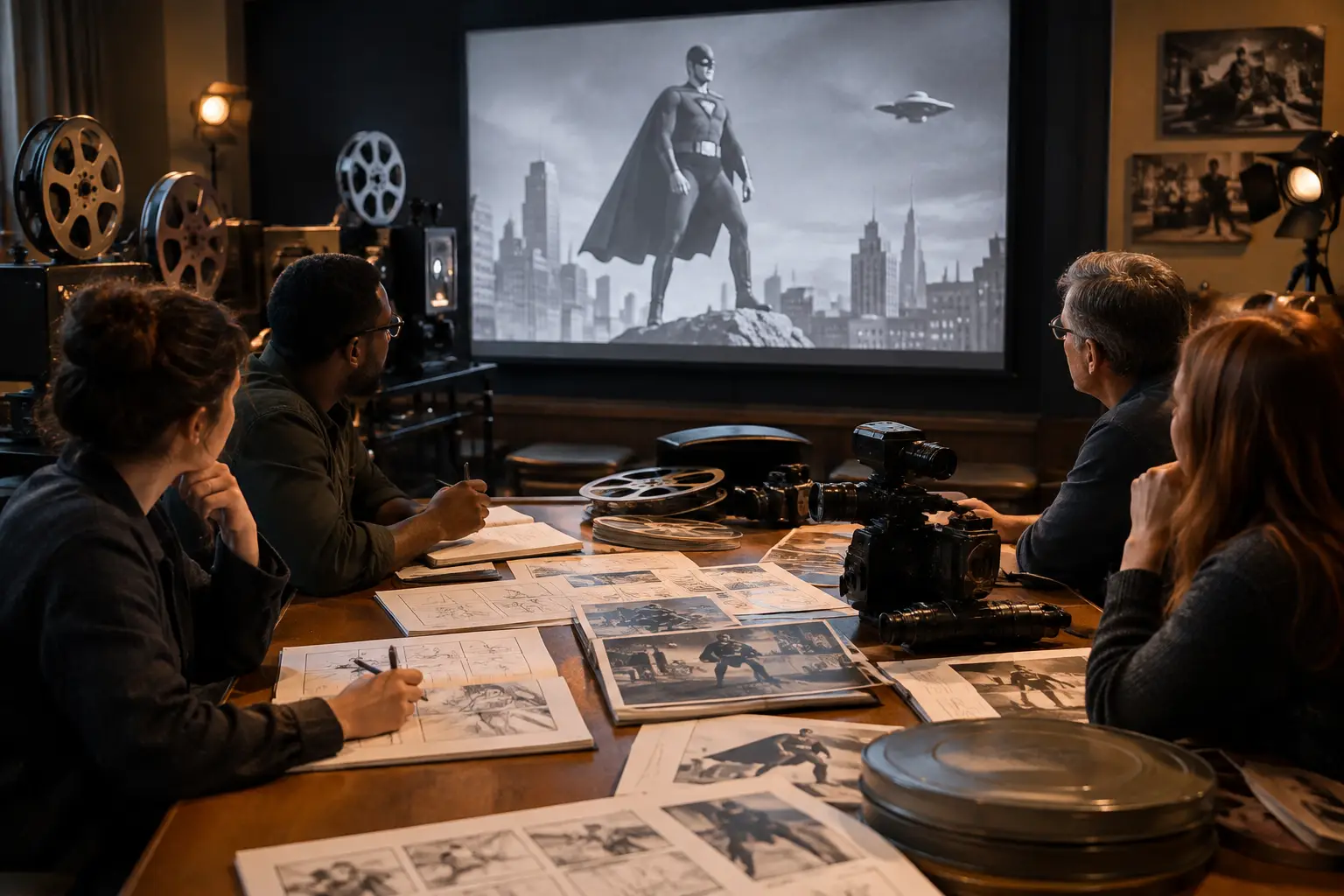
A locomotive tears through a darkened city street. An airplane drops out of the clouds. A mechanical monster sends shadows crawling across an Art Deco skyline. Then Superman rises into frame – not with the familiar arms-forward pose, but upright, fast, and strangely weightless. The best Fleischer Superman techniques made those moments feel bigger than a cartoon short had any right to feel in the early 1940s.
The seventeen Superman cartoons produced by Fleischer Studios and, later, Famous Studios remain landmarks because they treated animation as spectacle. Their stories are compact and often proudly pulpy: mad scientists, volcanoes, saboteurs, giant robots, and criminal masterminds. Yet the films endure because the action has physical force, the settings have atmosphere, and the hero moves like he belongs in a world with real gravity, real danger, and real scale.
Why Fleischer Superman Techniques Feel So Cinematic
The first surprise is how much of the series is built around mood. Many cartoons of the period favored clean staging, broad expression, and economical backgrounds designed to support rapid comedy. The Superman shorts wanted something different. They filled the screen with rain-slick streets, cavernous laboratories, towering machines, distant windows, and beams of light cutting through smoke.
That choice gave the cartoons a film-noir edge before noir had fully settled into its classic postwar form. Metropolis is less a cheerful comic-strip city than a place where trouble is always one block away. Its elevated trains, bridges, power stations, and midnight rooftops create ideal spaces for a hero who can suddenly appear above the action.
The production design also understood silhouette. Superman’s blue suit, red cape, and square shoulders read instantly against a moonlit sky or a bank of machinery. Villains tend to be defined just as clearly: a looming robot, a hooded figure, a sharp-nosed scientist bent over a control panel. Even when a short moves at breakneck speed, viewers never have to search for the important image.
Rotoscoping gave movement a human pulse
Rotoscoping is the technique most often associated with the Fleischer name. In simple terms, animators used filmed live-action movement as reference, tracing or interpreting frames to create convincing motion. The studio had used the process in earlier work, including the celebrated Cab Calloway dance sequences in Betty Boop cartoons. For Superman, rotoscoping was applied selectively to make major actions feel unusually grounded.
Watch Clark Kent shift into Superman, Lois Lane struggle against a threat, or the hero brace himself before lifting a massive object. The body weight is there. Knees bend, shoulders turn, and hands react to resistance. This is not realism for its own sake. It is realism placed where the story needs impact.
The trade-off is worth recognizing. Heavy reliance on rotoscoping can make animation look stiff or overly literal if every gesture is copied too closely. The Fleischer shorts are strongest when they balance observed movement with exaggerated cartoon timing. Superman may land with a believable bend in his legs, then cross the sky with impossible speed. That contrast sells his power.
The camera moves through a world with depth
Another signature of these films is their feeling of space. The studio used elaborate background construction, including miniature sets and layered artwork, to create tracking shots and shifting perspective. A camera can seem to glide down a street, past machinery, or through an industrial interior rather than merely pan across a flat painted backdrop.
This depth matters because Superman’s stories depend on vertical scale. He must look tiny beside a giant machine, then enormous when he stops it. A bridge needs to stretch into the distance before it can become a perilous rescue scene. The shorts repeatedly establish a location, let the eye travel through it, and then turn that location into an action arena.
Modern viewers may notice that some effects are more ambitious than perfectly smooth. That is part of their charm. The goal was not invisible technique. It was a heightened, theatrical sense that Metropolis had been built on a soundstage large enough for any crisis.
Fleischer Superman Techniques in the Action Scenes
The action in a Fleischer Superman cartoon usually begins with a problem the audience can understand in one image: a runaway train, a burning building, a weapon aimed at the city, or Lois in immediate danger. From there, the films escalate quickly. The animators use a few remarkably effective habits to keep the excitement clear.
First, they give danger time to register. A machine’s gears turn. A crowd looks upward. A beam of energy hums before it strikes. This brief preparation makes the next event land harder. Then the shorts cut between wide views of the disaster and closer shots of faces, levers, falling debris, or Superman’s determined expression.
Second, they make Superman solve problems physically. He does not simply arrive and erase the threat. He strains against collapsing structures, redirects vehicles, smashes through barriers, and uses his body as a shield. The animation invites us to feel the obstacle even when the result is never in doubt.
Third, the filmmakers use the cape as action punctuation. It snaps when he takes off, billows as he changes direction, and fills the frame in close shots. Animation often depends on secondary motion – the movement that follows a character’s main action. Superman’s cape makes every turn and landing more dramatic while preserving the clean silhouette that defines him.
The upright flight was a brilliant visual solution
Early comic-book Superman did not always fly in the way later audiences expect. He famously leaped great distances. The animated shorts transformed that ability into an upright, forward-rushing flight style that has become one of the character’s most memorable visual signatures.
It is an economical solution and an expressive one. By keeping Superman vertical, the animators retained his human form in the air. We see his chest, cape, boots, and face rather than a horizontal blur. He looks less like a projectile and more like a figure calmly commanding the sky.
That upright pose also works beautifully with the series’ cityscapes. Superman can rise between buildings, hover over a rooftop, or descend toward a disaster with a clear, iconic outline. Later interpretations would refine the familiar arms-forward flight pose, but the Fleischer approach remains thrilling because it feels so direct.
Shadow, Color, and the World of Metropolis
The Superman shorts were made in Technicolor, and they use color with remarkable discipline. The hero’s primary colors are vivid, but the surrounding city is often built from deep blues, gray-greens, purple shadows, warm warning lights, and bursts of orange fire. Superman stands out without looking pasted onto the frame.
Lighting is equally important. Searchlights sweep across walls. Laboratory equipment throws stark shapes onto the floor. A villain may be introduced as a dark form in a doorway before the camera reveals a face. These are simple visual choices, but they give short cartoons the tension of a serial cliffhanger.
This atmosphere is one reason the films reward repeat viewing. A first watch follows the rescue. A second watch catches the reflected light on a metal surface, the distant activity in a city window, or the way a foreground object frames a shot. The detail is never there just to look expensive. It makes the setting feel inhabited.
What Modern Animators Can Still Learn
The most useful lesson from the Fleischer Superman shorts is not that every production needs rotoscoping or miniature-backed camera moves. Those tools were tied to a particular studio, period, and budget. The larger lesson is that technique should serve the fantasy.
When Superman lifts a train, the filmmakers make the train feel heavy. When he flies over Metropolis, they make the city feel vast. When a criminal plot threatens civilians, they make the threat legible before the hero answers it. Every visual decision supports the same promise: this is a larger-than-life character in a world substantial enough to challenge him.
That is why the series still feels fresh beside newer superhero animation. Its storytelling is economical, but it never feels small. Each short offers a compact tour of a dramatic city, a bold threat, and a hero rendered with care.
For classic-animation fans, these cartoons are more than an early Superman chapter. They are a reminder that preservation is not only about keeping old films available. It is about keeping their craft visible. Put one on when you want to see a cape catch the light, a city fall into shadow, and a 1940s screen hero make the impossible look wonderfully solid.