

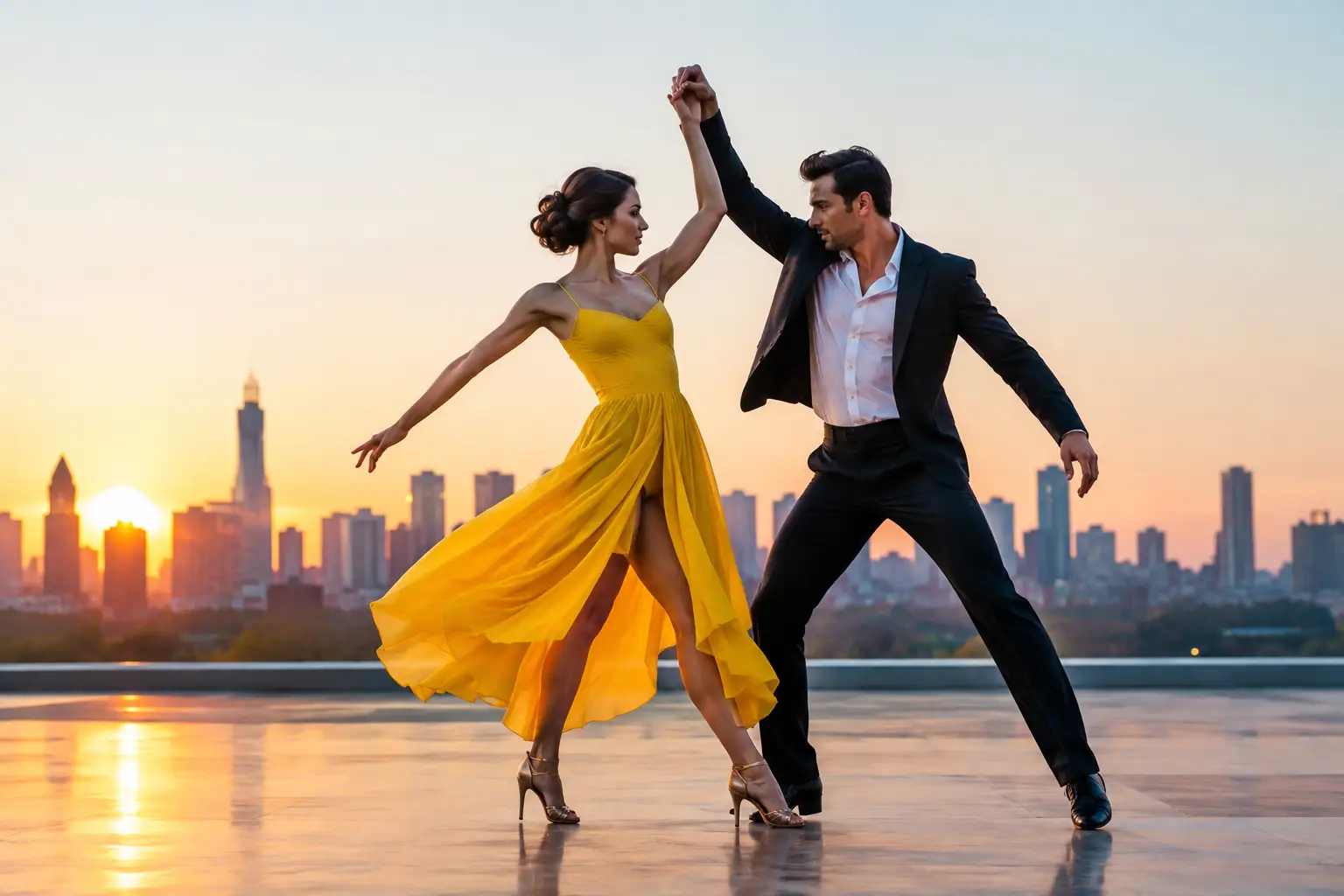
A great movie dance number does more than stop the story for a few minutes. It can turn a rainy street into a dream, make a ballroom feel weightless, or reveal more about two characters than a page of dialogue. The best Hollywood dance scenes endure because the stars seem to move with the camera, the music, and the movie’s whole sense of possibility.
For classic-film fans, these sequences are also miniature time capsules. They preserve the craft of studio-era choreography, practical sets, tailored costumes, and performers trained to make difficult movement look like a pleasant afternoon. Here are 12 scenes that remain essential viewing, whether you are revisiting familiar favorites or building a watchlist of vintage musical treasures.
12 Best Hollywood Dance Scenes to Revisit
1. “Cheek to Cheek” – Top Hat (1935)
Fred Astaire and Ginger Rogers glide through an Art Deco ballroom as Irving Berlin’s “Cheek to Cheek” turns romance into pure motion. The famous ostrich-feather gown caused headaches during filming, but on screen it adds a floating, almost otherworldly quality to Rogers’s movement.
What makes the scene special is its apparent ease. Astaire and Rogers do not dance at each other so much as they dance into perfect agreement. The number captures the polished fantasy that made the RKO musicals irresistible during the Depression: elegance is available for one song, one dance, one immaculate evening.
2. “Singin’ in the Rain” – Singin’ in the Rain (1952)
Gene Kelly’s rain-soaked celebration is so deeply woven into American movie memory that it is easy to forget how technically daring it is. Kelly dances through a nighttime street set, swings around a lamppost, splashes through puddles, and treats a storm as a personal spotlight.
The joy is infectious because it comes after a romantic breakthrough. Don Lockwood is not merely performing for an audience. He is too happy to walk home normally. That simple emotional logic gives the choreography its bounce, while the painted street, glowing lamps, and controlled rainfall create Hollywood magic with no need for modern effects.
3. “Good Morning” – Singin’ in the Rain (1952)
The same film earns a second place because Donald O’Connor, Debbie Reynolds, and Gene Kelly make a living-room rehearsal feel like a full-scale event. “Good Morning” builds from friendly chatter into an athletic trio number packed with taps, leaps, cane work, and rapid-fire comic timing.
Reynolds had less dance experience than her co-stars, which makes her crisp performance even more impressive. The number is a reminder that the best classic musicals often make hard work feel cheerful. Every turn is precise, yet the three performers give the illusion that they invented the routine five minutes earlier.
4. The Staircase Finale – The Band Wagon (1953)
Astaire’s solo to “Dancing in the Dark” is legendary, but the finale of The Band Wagon is where the film’s backstage energy bursts into grand spectacle. Cyd Charisse, in particular, brings a dramatic, sculptural presence that contrasts beautifully with Astaire’s lighter style.
The production knowingly plays with the scale of Broadway fantasy: towering sets, bold costuming, and dancers arranged like a moving mural. It is a useful counterpoint to Astaire and Rogers’s intimate ballroom work. Not every dance scene needs to feel natural. Sometimes the point is to make the screen feel too large for ordinary life.
5. “The Girl Hunt Ballet” – The Band Wagon (1953)
This extended noir parody gives Astaire a trench coat, Charisse a dangerous glamour, and the musical genre a sly sense of humor. The ballet follows a private-eye story, but its plot is really an excuse for smoky sets, stylized poses, and a dance performance that borrows the tension of crime pictures.
Charisse’s entrance in a red dress is one of classic Hollywood’s great star reveals. Her dancing has a feline control that makes every step look intentional. The number also shows how flexible the studio musical could be, borrowing the visual language of film noir without losing its rhythm or wit.
6. “Make ’Em Laugh” – Singin’ in the Rain (1952)
Donald O’Connor turns physical comedy into a marathon in this comic master class. He flips, crashes through props, runs up walls, and throws his entire body into the song’s promise that laughter matters more than dignity.
The routine is funny because O’Connor performs its punishment so seriously. A lesser performer might simply look exhausted. O’Connor makes exhaustion part of the joke, then finds another burst of energy. It is a valuable reminder that dance in Hollywood musicals was never limited to ballroom romance. Comedy, acrobatics, and character acting could all share the same floor.
7. “America” – West Side Story (1961)
The rooftop confrontation between Anita, Bernardo, and their friends uses dance to stage an argument about belonging, opportunity, and identity. Jerome Robbins’s choreography makes every snap, stomp, and turn feel connected to the debate. The dancers are not pausing the drama. They are fighting through it.
The 1961 film’s location-conscious visual style gives the number an urgency that earlier studio musicals rarely sought. Its energy remains startling, though viewers should also recognize the film’s dated casting practices and simplified view of Puerto Rican life. The scene is historically important and electrically performed, but appreciation benefits from context.
8. “The Jets’ Song” – West Side Story (1961)
Before the romance and tragedy take over, the Jets establish their territory with angular movement and aggressive precision. The choreography is compact compared with the film’s bigger set pieces, but that is exactly why it works. Each kick and shoulder turn tells us how these young men see themselves: tough, restless, and bound together.
Robbins brought a theatrical sharpness to the film that influenced generations of screen choreography. The number is less about grace than attitude, proving that a memorable dance scene can be tense, messy, and deliberately uncomfortable.
9. “Steppin’ Out with My Baby” – Easter Parade (1948)
Fred Astaire and Judy Garland take a fashion-show setting and turn it into a joyous parade of color and rhythm. Astaire’s top hat and cane suggest classic sophistication, while Garland brings a warmer, more playful energy that keeps the number from becoming too formal.
Their partnership differs from Astaire’s work with Rogers. There is less of the cool, romantic glide and more friendly show-business sparkle. The effect is ideal for a film built around performance, costume, and the pleasure of seeing a star command the stage.
10. “Moses Supposes” – Singin’ in the Rain (1952)
Gene Kelly and Donald O’Connor transform a diction lesson into a tap challenge. The premise is wonderfully small: a speech coach insists on proper enunciation, and the students respond by making a game of it. Soon, desks, chairs, and polished shoes become instruments.
This is classic Hollywood at its most resourceful. A single room, two gifted performers, and a clever idea are enough to create a number with lasting replay value. Watch the way Kelly and O’Connor trade steps without losing the scene’s comic story.
11. “Shall We Dance” – The King and I (1956)
Yul Brynner and Deborah Kerr bring restraint, tension, and unexpected tenderness to this ballroom sequence. The King’s invitation is formal, even commanding, but the dance gradually becomes a moment of connection between two people who rarely agree.
The scene succeeds because neither performer pushes it into easy romance. Kerr’s Anna maintains her poise, while Brynner lets flashes of uncertainty show beneath the King’s authority. Their movement carries the emotional weight of a conversation that cannot be spoken plainly.
12. “I Wanna Be Loved by You” – Some Like It Hot (1959)
Marilyn Monroe’s “I Wanna Be Loved by You” is not a large ensemble dance, but it belongs in any conversation about movement and movie stardom. Her gentle sway, breathy phrasing, and direct connection with the camera turn a simple stage performance into a lasting screen image.
The scene shows that choreography is not always about difficult footwork. Sometimes it is about timing, silhouette, personality, and knowing precisely how much to hold back. Monroe makes the performance feel intimate even within Billy Wilder’s fast-moving comedy.
Why Classic Dance Numbers Still Feel Alive
The finest Hollywood dance scenes were built around performers rather than edited around limitations. Cameras often stayed wide enough for audiences to see the bodies doing the work. That choice matters. A clean shot lets the viewer appreciate Astaire’s precision, Kelly’s athletic drive, Charisse’s dramatic lines, and O’Connor’s fearless comic control.
These films also understand that music and character belong together. A dance can express courtship, ambition, rivalry, nervousness, or sheer relief. Modern productions may have bigger budgets and faster cutting, but a classic number often feels more immediate because the emotion is carried by an actual performer in an actual space.
The next time a familiar melody begins, resist the urge to skip ahead. Let the camera hold, watch the shoes, notice the set details, and enjoy the pleasure of a studio-era performer making an impossible routine look like the most natural thing in the world.