

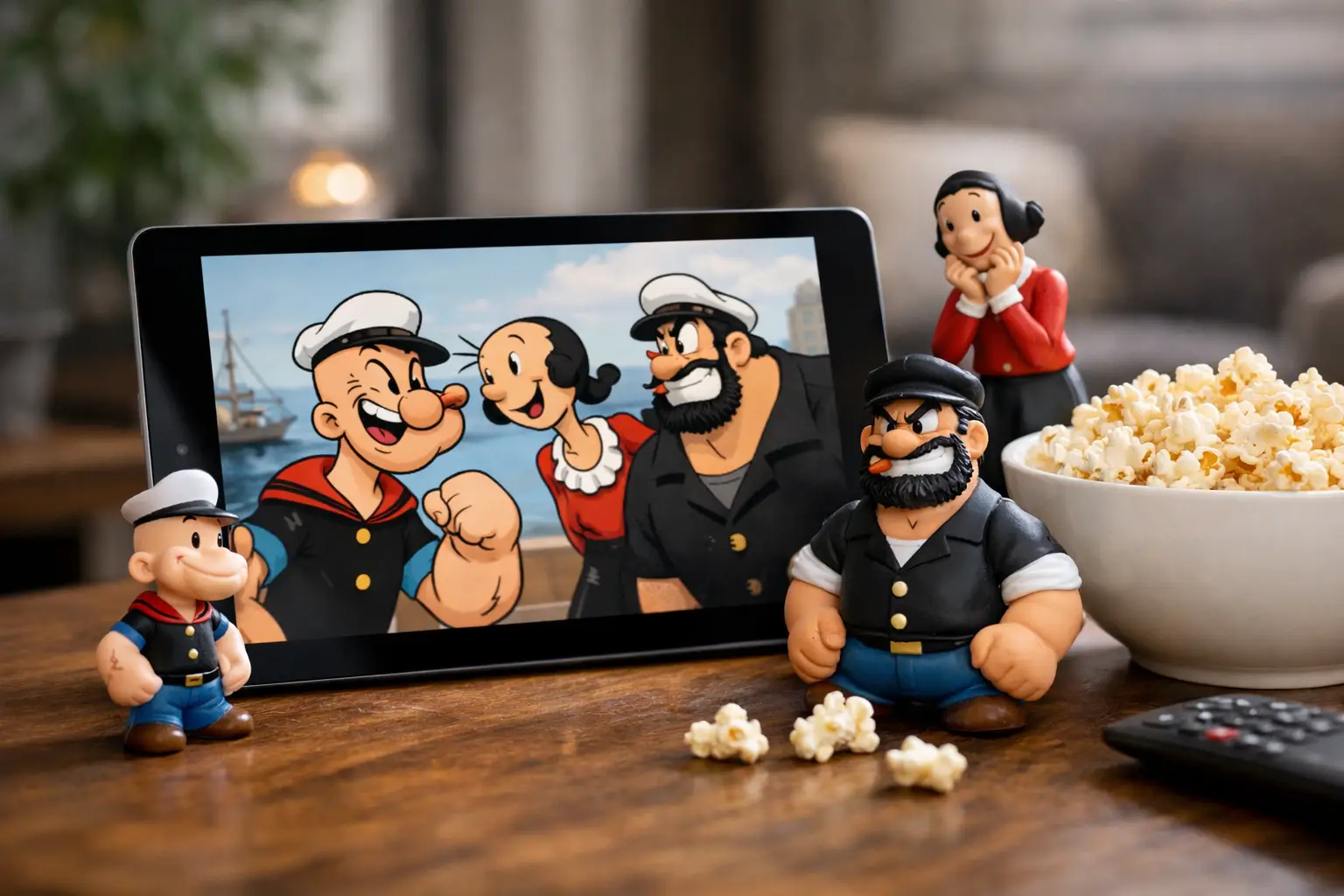
Popeye cartoon episodes do not need a long runway. A muttered insult, a crooked scheme from Bluto, and a can of spinach are usually enough to put the sailor on course. Yet the best shorts offer far more than a familiar punchline. They carry the energy of early theatrical animation, the sly humor of the Depression era, and a visual imagination that still feels surprisingly alive.
For classic-cartoon fans, Popeye is not one fixed series. The character traveled through distinct studio eras, changing in design, pacing, color, music, and mood while holding onto his essential appeal: a scrappy underdog who keeps getting back up. That makes revisiting these shorts especially rewarding. A single afternoon can move from surreal Fleischer animation to bright postwar comedy and later television-friendly adventures.
Why Popeye Cartoon Episodes Still Play So Well
Popeye works because the formula is sturdy without becoming empty. Popeye wants a quiet meal, a date with Olive Oyl, or a fair chance to do the right thing. Bluto – sometimes called Brutus in later material – turns that ordinary goal into a contest. Popeye absorbs an absurd amount of punishment, finds spinach when the moment is right, and restores order with a burst of impossible strength.
That structure leaves room for the animators to have fun. A fight can become a rolling storm of fists, pipes, barrels, and bent scenery. A ship can sway like rubber. Popeye’s forearms can turn into tools, weapons, or visual gags in the space of a second. The shorts are fast, but they are rarely rushed. Much of their pleasure comes from noticing the tiny bits of business around the main joke: a background character’s reaction, Olive’s peculiar stride, or Popeye talking through his pipe with complete confidence.
The voices matter just as much. Popeye’s gravelly, half-understood commentary makes him feel less like a polished hero and more like a sailor who happened to wander into a cartoon. Olive Oyl is frequently impatient, theatrical, and tougher than viewers remember. Bluto is a great comic obstacle because he is huge, loud, and often undone by his own overconfidence.
For younger viewers, the basic story is easy to follow. For longtime fans, the episodes reward attention to animation technique, period jokes, and studio personality. That range is a large part of why Popeye has lasted.
The Fleischer Years: The Essential Popeye Cartoons
When most animation collectors talk about the finest Popeye cartoon episodes, they are usually thinking of the Fleischer Studios shorts made from 1933 into the early 1940s. These theatrical films have a lively, often strange quality that separates them from many later TV cartoons. Characters stretch, bounce, and react with a physical weight that makes every tumble and punch land.
The early black-and-white entries are compact comic machines. They often begin with a simple setting – a carnival, a dock, a rough neighborhood, a ship – and then push it toward total chaos. The studio’s animation has an earthy, slightly offbeat feeling. Popeye might be heroic, but he is never elegant. That roughness is the point.
Several shorts also preserve a remarkable slice of popular entertainment history. Music, slang, dance routines, and working-class settings give them a time-capsule quality without making them feel like homework. The songs are catchy, the action is direct, and the gags remain readable decades later.
The color specials are made for a bigger screen
The Fleischer color two-reelers deserve special attention. These longer Popeye adventures take the sailor into storybook territory, including sweeping journeys inspired by Sinbad the Sailor, Ali Baba, and Aladdin. They are more elaborate than the standard shorts, with rich color, larger sets, memorable villains, and a sense of scale that still impresses.
They also show a different side of Popeye. Instead of settling a neighborhood quarrel, he becomes an unlikely adventure hero crossing strange islands, caves, and kingdoms. The comedy remains broad, but the settings invite viewers to linger over the artwork. If someone thinks vintage cartoons are visually limited, these specials are an excellent correction.
From Fleischer to Famous Studios
After the Fleischer era, the series continued under Famous Studios. The postwar cartoons often look cleaner and brighter, with a more polished house style. They can be easier for casual viewers to enter because the stories are direct and the color design is cheerful. The trade-off is that some fans miss the odd, elastic edge of the earlier films.
That does not make the Famous Studios period a lesser destination. Many of these shorts are warm, funny, and packed with the dependable character dynamics audiences expect. They also broaden Popeye’s world through domestic comedy, travel stories, sporting contests, and holiday situations. Watching across the transition is one of the best ways to see how a major cartoon character can remain recognizable while the industry around him changes.
The later theatrical episodes are particularly satisfying when viewed as part of a run rather than judged against one legendary early short. Their rhythms become clear: Popeye’s stubborn decency, Olive’s big emotions, Bluto’s schemes, and the timing of a perfectly placed spinach rescue.
How to Choose Popeye Cartoon Episodes for Your Mood
A curated Popeye watchlist is more useful when it follows your mood instead of a strict release order. Start with early Fleischer black-and-white shorts when you want fast gags, strange settings, and the raw spark of 1930s animation. Choose the color adventures when you want a mini-feature with spectacle and fantasy.
For lighter, easygoing viewing, postwar Famous Studios episodes offer colorful comedy and familiar situations. Television-era Popeye can be a comfortable choice for viewers looking for shorter, simpler stories, although the limited animation and production pace will feel different from the theatrical classics.
It also helps to watch several episodes from the same period before moving on. One short can be entertaining; three or four reveal the studio’s habits, from the way characters move to how music shapes a gag. That is where classic animation starts to feel less like a collection of old clips and more like a living creative tradition.
What to Look for Beyond the Spinach
The spinach gag is famous for good reason, but it should not be the only thing you watch for. Listen to how music directs the action. In many Popeye shorts, the score does not merely sit in the background – it accelerates a chase, punctuates a fall, and turns a brawl into a rhythmic performance.
Look at the backgrounds, too. Fleischer city streets and waterfronts can feel crowded, moody, and almost dreamlike. Later color settings are often bolder and more decorative. Both approaches tell you something about the era that produced them.
There is also the pleasure of seeing a character who is not built for perfection. Popeye is awkward, short-tempered, and frequently outmatched. His appeal comes from persistence, not polish. He keeps standing up for Olive, for Swee’Pea, for strangers, or simply for what he thinks is fair. The spinach gives him power, but the character’s real engine is stubborn loyalty.
Building a Better Classic Cartoon Night
Popeye pairs naturally with other theatrical cartoon favorites, but he can easily carry the program alone. Try beginning with an early black-and-white short, following it with a color special, then ending on a postwar episode. The contrast makes the evolution of the series visible without turning the evening into a history lesson.
Pay attention to presentation, too. Vintage animation benefits from a clean transfer that preserves contrast, detail, and the character of the original artwork. Some viewers prefer the texture of older prints; others enjoy enhanced or remastered editions that bring out line work and color. It depends on whether you are chasing the feeling of an old theater or a clearer view of the animators’ craft.
At HetFlix, Popeye belongs in the same conversation as Betty Boop, Superman, and the other screen legends that made early animation an event. Put on an episode when you want ten minutes of comic trouble with real personality. Chances are Popeye will still have the last laugh – right after he opens the spinach.