

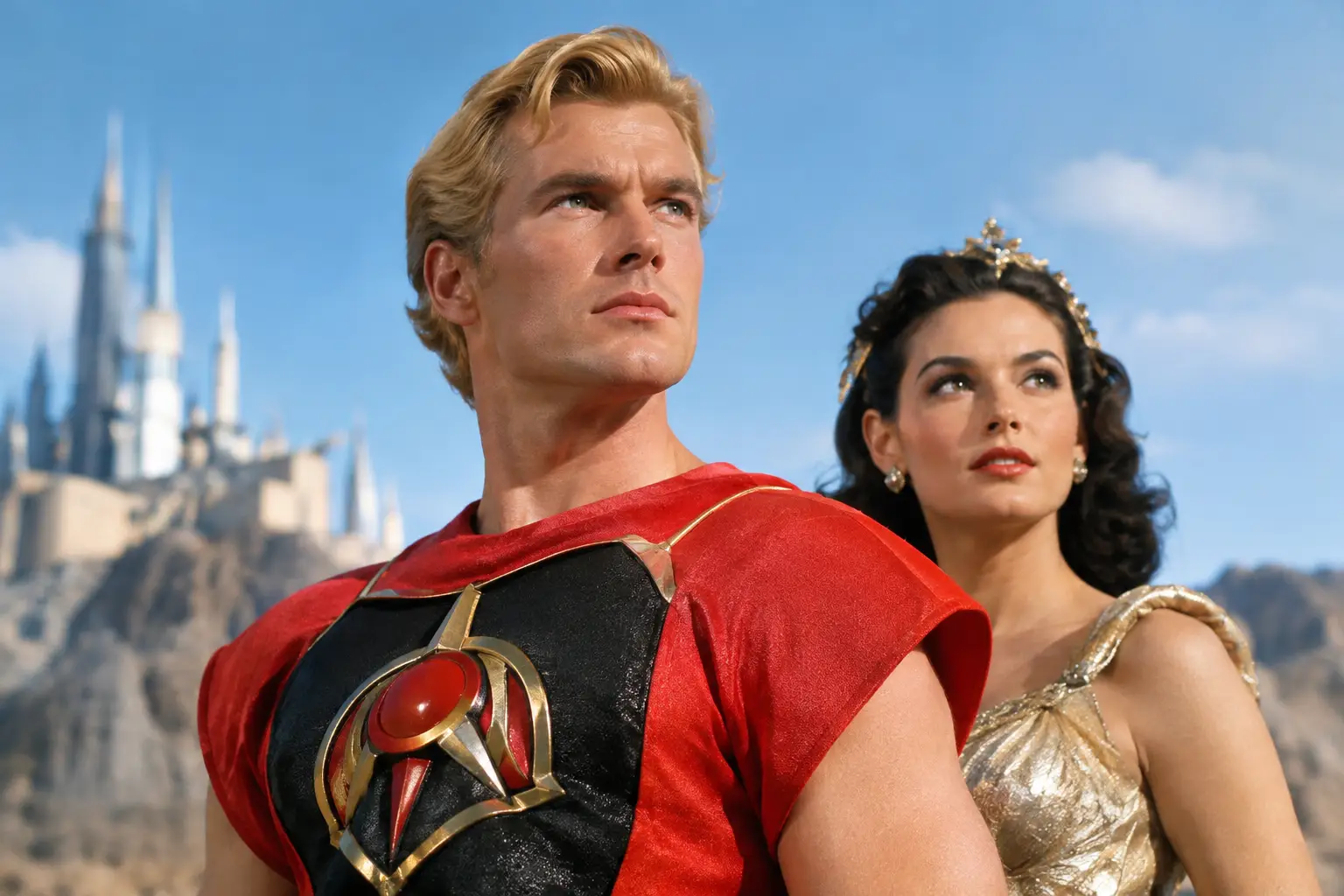
A rocket ship cuts through painted stars. A hero in a polo shirt faces a tyrant in ceremonial robes. Then, just as escape seems possible, the screen cuts to: “To Be Continued.” The best Flash Gordon serials retain that jolt because they never pretend space adventure should be sensible before it is exciting. They are pure forward motion – strange planets, impossible inventions, perilous escapes, and one of cinema’s most unforgettable villains.
For classic-screen fans, the theatrical Flash Gordon serials are also more than nostalgic curiosities. Made between 1936 and 1940, they helped establish the visual grammar later borrowed by television science fiction, comic-book adventures, and space operas. There are only three core serials, so the real question is not which ones count. It is which one should be your first stop.
The 3 Best Flash Gordon Serials, Ranked
1. Flash Gordon (1936)
The original remains the essential choice. Flash Gordon introduces Buster Crabbe as the all-American polo player swept from Earth to Mongo alongside Dale Arden, played by Jean Rogers, and scientist Hans Zarkov, played by Frank Shannon. Their destination is a kingdom of competing races and spectacular dangers, all controlled by Emperor Ming the Merciless.
Charles Middleton’s Ming is the serial’s great achievement. His performance is cool, theatrical, and menacing without needing naturalism. Ming does not simply threaten Flash. He presides over Mongo as though cruelty were a formal court ritual, which gives every scene with Dale an extra charge of danger. Crabbe, meanwhile, plays Flash with athletic directness. He is not a complicated hero, but he is exactly the right hero for a chapter serial: quick to act, hard to intimidate, and always ready to swing from a rope or commandeer a ray gun.
The 1936 production has the richest sense of discovery. Mongo feels like several pulp-magazine covers brought to life: Hawkmen soar above miniature cities, strange creatures stalk underground chambers, and every corridor appears to lead toward another trap. The budget limitations are visible, but they are part of the charm. Model rockets, painted backdrops, and ornate costumes create a handmade fantasy world with its own logic.
This is the best entry point for newcomers and the strongest choice for viewers who want the full foundation of Flash lore. Its 13 chapters move quickly, although modern audiences may notice repeated recaps and a few scenes that linger to stretch the running time. Those are serial mechanics, not failures. The reward comes in watching the creators find a new cliffhanger every week.
2. Flash Gordon Conquers the Universe (1940)
If the first serial is the most imaginative, Flash Gordon Conquers the Universe is the most urgent. By 1940, Flash was already a familiar screen hero, and this 12-chapter serial treats him with greater confidence. Ming returns with a weapon capable of spreading destruction across worlds, while Flash, Dale, and Zarkov race through a story that feels darker and more openly threatened by war.
The title promises a grand scale, and the serial delivers it through momentum rather than expensive spectacle. Flash faces death rays, plagues, hostile landscapes, collapsing sets, and Ming’s latest schemes at a pace that rarely stops to catch its breath. Much of its visual material is reused from the earlier chapters, a common cost-saving practice in serial filmmaking. For some collectors, that reuse makes it less visually fresh than the 1936 original. For others, it gives the trilogy a welcome storybook continuity.
What lifts this installment is the atmosphere. The looming conflict in Europe had changed the public mood, and the serial’s fear of a ruthless power threatening the whole universe lands differently than it did a few years earlier. Ming is still an extravagant pulp villain, yet the stakes feel less playful. Flash’s mission has become defense, not merely survival.
Choose this one if you already know the basic characters and want the tightest, most dramatic Flash Gordon experience. It is also the best pick for a one-sitting serial marathon, provided you are ready for the wonderfully repetitive chapter-end rescues that define the form.
3. Flash Gordon’s Trip to Mars (1938)
Flash Gordon’s Trip to Mars occupies a fascinating middle ground. It has more chapter-to-chapter ambition than its reputation sometimes suggests, moving the action beyond Mongo and into a new planetary setting ruled by Queen Azura. The result is a serial packed with poisonous plants, transformed humans, subterranean threats, and a villainous court every bit as theatrical as Ming’s.
Its 15 chapters give the story room to build an unusually elaborate set of complications. Flash and his companions must contend with Azura’s power while Ming’s influence remains close at hand. That density is the appeal for devoted serial fans. It often feels like the writers refused to discard a good pulp idea simply because they had already used three others in the same chapter.
The trade-off is pacing. Trip to Mars can feel more meandering than either the original or Conquers the Universe, particularly when viewed all at once. A serial was designed for weekly attendance, with each chapter supplying reminders and fresh jeopardy for viewers returning to the theater. Seen in a binge, the repetition can be noticeable.
Still, that makes it a rewarding second or third watch rather than a lesser curiosity. Jean Rogers has a stronger presence here, the production leans fully into its bizarre fantasy elements, and the serial offers some of the franchise’s most memorable visual oddities. For viewers who love the stranger corners of vintage science fiction, this may become the personal favorite.
What Makes These Flash Gordon Serials Special?
The Flash Gordon serials are often remembered for their influence on later space adventures, and that influence is real. Their mixture of planetary kingdoms, ray guns, aerial battles, and serialized peril became a template that generations of filmmakers and comic creators would revisit. But influence alone is not why they remain fun.
They work because they understand the pleasure of the cliffhanger. Each chapter gives Flash a clear problem, puts him in trouble, and leaves the audience wanting the next reel. The solutions are sometimes wild, occasionally convenient, and nearly always entertaining. Flash may escape a death trap through a hidden passage, a last-second rescue, or a device Zarkov happens to have brought along. The point is not to outguess the mechanism. The point is to enjoy the rush.
The trio at the center also gives the fantasy a human anchor. Flash supplies courage, Dale supplies emotional stakes and determination, and Zarkov supplies the scientific explanation – however fanciful – for the latest danger. Their sincerity keeps the adventures from becoming mere camp. They play the impossible as if it matters, and that is why it still does.
How to Choose Your First Flash Gordon Serial
Start with Flash Gordon if you want the series at its most iconic. It has the strongest introduction to Mongo, the cleanest version of the characters, and the serial images most people picture when they hear the name Flash Gordon.
Start with Flash Gordon Conquers the Universe if you prefer faster action and a more dramatic tone. It is the polished late entry, even if its recycled material occasionally reveals the realities of studio economics.
Save Flash Gordon’s Trip to Mars for when you want maximum pulp imagination. It is longer, stranger, and a little less streamlined, but those qualities make it a treat for viewers who enjoy getting lost in the serial format.
For the fullest experience, watch them in release order. You will see the production evolve from its first grand trip to Mongo into a familiar universe with recurring threats, returning faces, and ever-more-ambitious promises. The changes are modest, yet they reveal how Republic-era adventure entertainment learned what its audience came back to see.
A Classic Worth Returning To
These serials were built for an audience that paid a few cents, found a seat in a dark theater, and gladly returned next week to learn whether Flash survived. That simple contract still holds. Put on the first chapter, accept the miniature rockets and thunderous narration, and let Mongo do the rest. For a curated route back to the rocket-age imagination of classic screen adventure, add the trilogy to your HetFlix watchlist and keep the next chapter close at hand.