

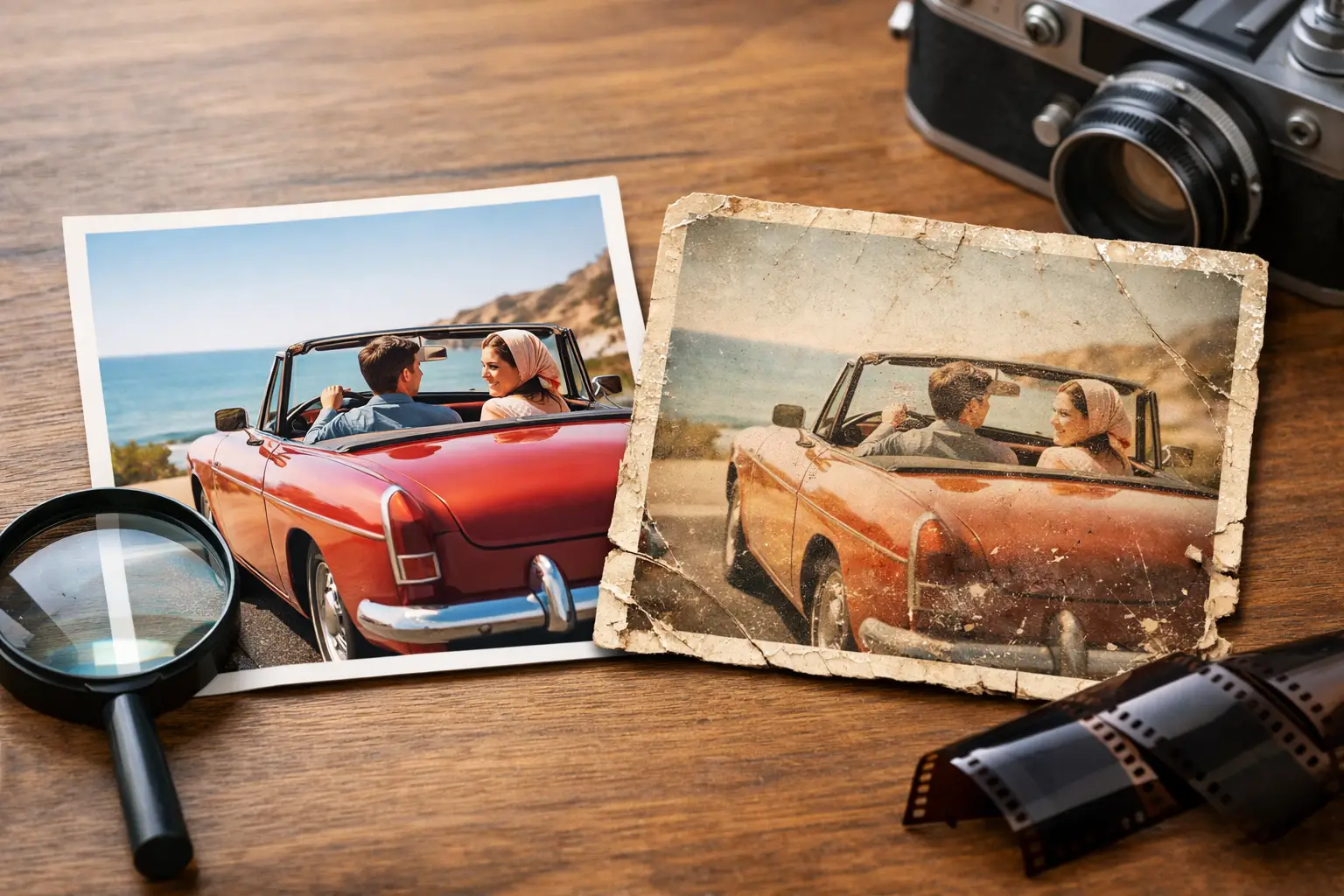
A Popeye short can look startlingly fresh after a careful restoration: crisp linework, bright color, and music that no longer seems trapped behind a curtain of hiss. Then an original print appears, complete with grain, soft edges, and the occasional splice, and suddenly the screening feels closer to 1940. That is the real appeal of restored classics vs original prints. This is not simply a contest between clean and dirty. It is a choice between different ways of meeting the past.
Why the Print Changes the Experience
Classic films, cartoons, serials, and early television were made for physical media. A nitrate film reel, a 16mm television print, and a later duplicate can all carry the same title while looking and sounding noticeably different. Time leaves its mark through fading, scratches, shrinkage, missing frames, warping, and generations of copying.
An original or vintage print can preserve qualities a modern version may smooth away. Film grain gives a black-and-white noir its shadowy texture. Slightly uneven exposure can make a low-budget western feel like it is playing at a neighborhood theater. The flutter of an old soundtrack can even become part of the atmosphere, especially for viewers who grew up with these movies on late-night television.
But authenticity is not the same thing as damage. A print may be historically original and still be a poor representation of what its creators intended audiences to see. Dust was not a creative decision. Neither was a large scratch across Betty Boop’s face or dialogue buried beneath decades of crackle.
Restored Classics vs Original Prints: What Changes?
Restoration starts with a source element, ideally the original camera negative or the earliest surviving fine-grain master. Specialists scan the material at high resolution, stabilize unsteady frames, repair tears, remove debris, correct color fading, and improve sound. The goal is usually to reveal information already present in the film, not to invent a new version of it.
The difference can be dramatic. In a restored Superman cartoon, backgrounds regain depth, red-and-blue costumes separate clearly, and fast action becomes easier to follow. A serial such as Flash Gordon can reveal set details that were lost in murky public-domain copies. Silent films benefit especially from stable images and cleaner musical accompaniment, because every expression and visual gag carries the story forward.
Yet restoration involves judgment. How much grain should remain? Should a faded title card be recreated? Is a soundtrack’s high-frequency hiss reduced until dialogue is clear, or until voices begin to sound thin and artificial? Every choice affects the result.
This is why “restored” is not automatically a promise of perfection. Excellent work is respectful, patient, and transparent about the material’s limits. Poor work can leave images waxy, erase fine animation lines, overbrighten scenes meant to be dark, or push color so far that a familiar cartoon no longer resembles its original release.
The Best Restoration Feels Like a Clearer Window
The strongest restorations do not make a 1930s short look like a brand-new digital production. They make it easier to see the artistry that was there all along. Hand-painted backgrounds, practical effects, costume texture, and the careful timing of a gag all come forward without losing the character of film.
For collectors and historians, this matters because older screen media is often judged by the worn copies that happened to circulate. A thoughtful remaster can change a viewer’s first impression of a title once dismissed as primitive, cheap, or hard to watch.
What Original Prints Still Give You
Original prints offer evidence. Their opening logos, censorship marks, reel changes, leader footage, subtitles, distributor edits, and even signs of exhibition can tell a story beyond the feature itself. A vintage print may preserve a cut scene, an alternate title, or period color timing that a later restoration does not include.
There is also a particular pleasure in seeing media with its physical history intact. The slight pop at a reel change in a Republic serial can create the sense of a Saturday matinee. A soft, grainy television image can suit a childhood favorite better than an aggressively polished transfer. For some fans, those imperfections are not distractions. They are part of the memory.
That preference deserves respect, but it is personal rather than universal. A viewer discovering Dick Tracy for the first time may want a clear image and understandable dialogue. A devoted serial collector may want the surviving print exactly as it was found. Both audiences are looking for a genuine connection to the same material.
The Question Is Not Always “Which Is Better?”
The better version depends on why you are watching. If your goal is pure enjoyment, a well-restored edition is usually the welcoming choice. It reduces the barriers between the viewer and the story. You can focus on Popeye’s comic timing, a film-noir mystery, or the cliffhanger at the end of a Captain America chapter instead of fighting dim visuals and distorted audio.
If you are studying film history, original prints and archival transfers can be equally valuable. They reveal what survived, how a title circulated, and how presentation changed across decades. A restored release may be ideal for appreciating a production’s craft, while an unaltered print is ideal for understanding its material journey.
There are also titles for which no perfect element survives. In those cases, restoration may combine the best available sources: one reel from a sharp but scratched print, another from a cleaner but incomplete copy, and audio from a separate track. The result can be more watchable than any single surviving source, even if it cannot fully recreate the premiere-night experience.
Be Careful With Colorization and Heavy Enhancement
Colorized editions belong in a slightly different conversation. They can make an older title feel approachable for viewers who avoid black-and-white entertainment, and they can offer a fresh way to revisit a familiar cartoon or comedy. When presented as an alternate edition, colorization can be a fun addition to a classic library.
It should not be mistaken for the original visual design. Black-and-white cinematography was often built around contrast, lighting, makeup, and shadow. A color version changes that language. The same is true of heavy motion smoothing, artificial sharpening, and digital noise reduction. These tools may be tempting, but more processing is not always more faithful.
The most collector-friendly approach is simple: preserve access to the original look whenever possible, then offer enhanced versions clearly labeled as enhanced. Choice lets audiences enjoy a classic on their own terms.
How to Watch With a Collector’s Eye
You do not need a projection booth or a shelf of rare reels to notice the difference. Start by paying attention to the image rather than treating it as background. Is the grain natural and moving with the picture, or has it been scrubbed away? Are shadows still rich, or have dark scenes been lifted into gray? Does the sound have a little age without making speech difficult to hear?
Consider the source, too. A 4K scan can be extraordinary, but resolution cannot restore detail that a battered duplicate never contained. Conversely, a modest-looking transfer may be the most honest presentation available for a rare television episode or forgotten short. Scarcity changes the standard. Saving a watchable copy can be an achievement in itself.
At HetFlix, the joy of classic entertainment is not limited to one ideal presentation. It is in being able to revisit the titles, characters, and eras that modern streaming catalogs too often leave behind. A polished restoration can make a favorite feel newly alive. An original print can make it feel wonderfully close to its own time.
The next time you choose between versions, let the title guide you. Watch the restoration when you want the story and craftsmanship to come through with clarity. Seek out the original print when you want to feel the history in the frame. Either way, give the classic your full attention – it has survived long enough to earn it.