

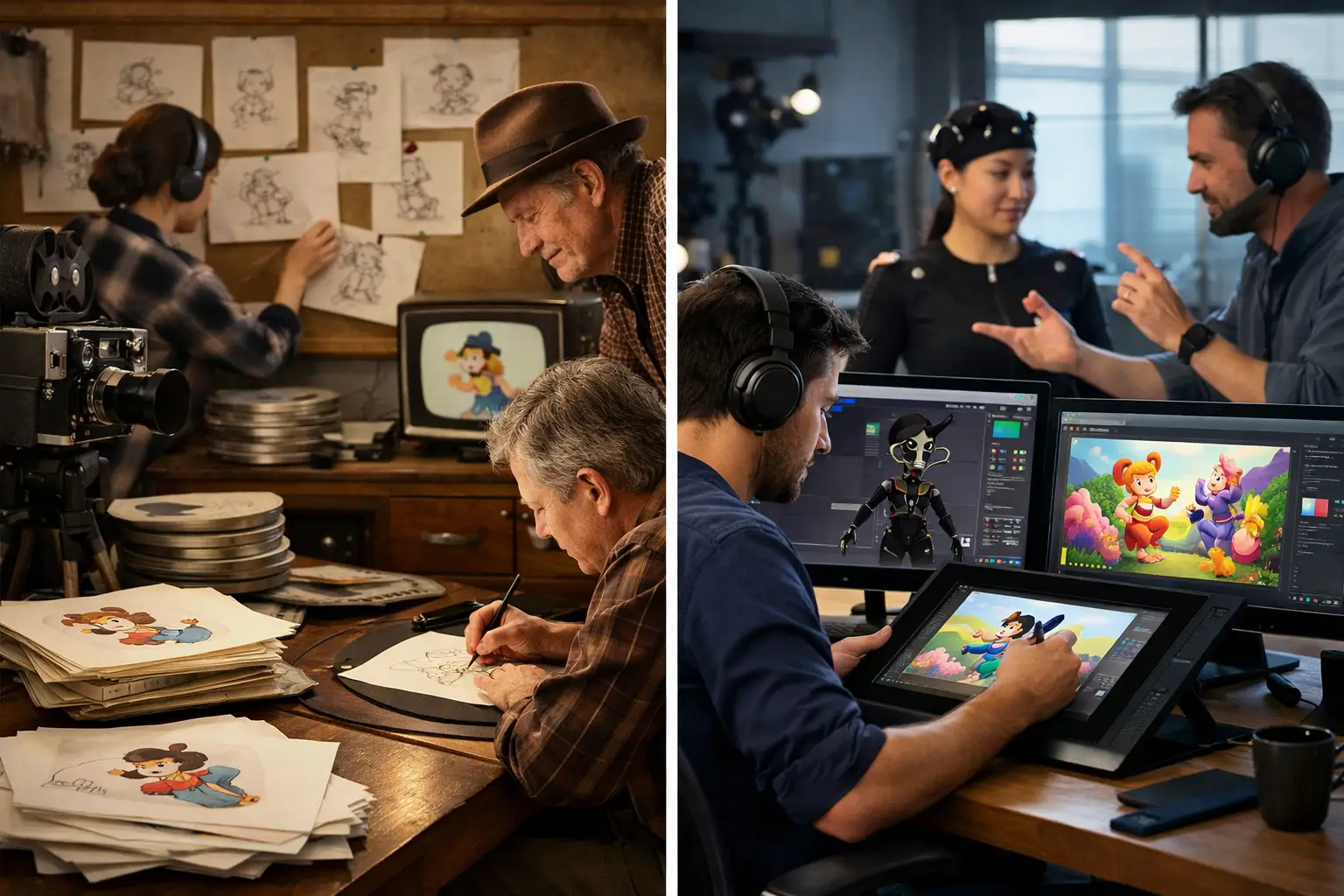
A Popeye punch can land with the force of a cannon blast. A Looney Tunes chase can turn a quiet country road into a full orchestra of whistles, crashes, and perfectly timed pauses. Watch these shorts beside a modern animated series, and the difference is immediate. So, why are old cartoons different? Because they were made for a different screen, a different business, and an audience that expected animation to be a full theatrical event.
Classic cartoons were not simply early versions of what we watch now. They were their own form of popular entertainment, shaped by movie palaces, hand-drawn production, live music, newspaper gags, vaudeville, and the fast-moving demands of a weekly release schedule. Their style can feel wild, elegant, strange, or surprisingly sophisticated because the rules were still being invented.
Why Are Old Cartoons Different? They Were Made for Theaters
For much of animation’s golden age, cartoons played before the feature film. A seven-minute short had to win over a room full of people quickly, often before the main attraction even began. That meant bold opening images, unmistakable character poses, energetic music, and a joke that read clearly from the back row.
The theatrical setting explains the grand scale of classics starring Popeye, Betty Boop, Superman, and the stars of Warner Bros. Animation was designed to fill a large screen and compete with the sound and spectacle of live-action films. Even a simple gag could build into a spectacular chain reaction because that escalation gave audiences a payoff worth hearing in a packed theater.
Modern cartoons are often made for television, streaming, or mobile viewing. They may have more time to develop a story, build a season-long arc, or let a character’s personality carry a quieter scene. That is not a decline in quality. It is a different assignment. A theatrical short needed a complete comic experience in minutes; a streaming series can let a joke breathe across an episode or several seasons.
The Hand-Drawn Process Put Personality in Every Frame
Old cartoons look different because they were built differently. Artists drew poses, expressions, effects, backgrounds, and movement by hand, then photographed the artwork one frame at a time. The result was labor-intensive, but it gave the medium a physical, human character. A character’s walk might bounce, stretch, snap into a pose, then hold for a split second so the audience could enjoy the expression.
Those holds are part of the magic. In modern animation, viewers may be used to smooth, continuous motion. In a classic short, a sudden freeze or sharply exaggerated pose can be funnier than realistic movement. Animators understood that comedy was not about reproducing life exactly. It was about selecting the most entertaining version of it.
This is why a character can squash flat after a fall, inflate like a balloon, or run straight through a wall and leave a character-shaped hole behind. The body follows the gag, not anatomy. That visual freedom made cartoons feel unlike live action and unlike much of today’s more polished digital animation.
There were trade-offs. Reused animation cycles, static backgrounds, and simplified movement sometimes appeared when studios had to save time or money. Television animation of the 1960s especially relied on limited animation, where a character’s mouth or arm might move while the rest of the image stayed still. Yet inventive directors often turned those limits into a graphic style with memorable designs and strong comic timing.
Music Did More Than Fill the Silence
In many old cartoons, the score is practically another cast member. Characters move to the beat, objects crash on a musical accent, and a chase can shift tempo as quickly as the action. This approach grew partly from the animation process itself: music and sound effects were carefully matched to finished footage, creating the famous bounce, slide, and crash of cartoon sound.
The connection to popular songs also made these shorts feel current in their own era. Audiences recognized tunes from radio, stage shows, and dance halls. A familiar melody could establish a mood instantly, then become the foundation for a gag. Today, the reference may be less obvious, but the rhythm still works. You do not need to know the original song to understand that a character is strutting, sneaking, panicking, or falling in love.
Voice acting had a similarly oversized role. The gravel in Popeye’s mutter, the cool confidence of a classic cartoon rabbit, or the frantic bark of a villain gave characters an identity that survived changes in plot and setting. These were performances built for instant recognition, not naturalistic conversation.
The Humor Came From Vaudeville, Comics, and the Times
Classic animation borrowed freely from the entertainment around it. Vaudeville supplied visual routines, comic double takes, songs, and broad character types. Newspaper strips brought recognizable cartoon logic. Silent film comedy contributed chases, stunts, and jokes that could be understood with little dialogue.
That is one reason older shorts can seem faster and more physical than newer ones. A character does not just trip. The trip becomes a staircase collapse, a rolling barrel, a runaway train, and a final crash through a sign. The story is often a delivery system for momentum.
At the same time, old cartoons are products of their period. Some contain stereotypes, casual violence, gender roles, or cultural references that now feel uncomfortable or unacceptable. Preserving classic animation does not require pretending those elements are harmless. Context matters. A curated library can make room for the artistry, influence, and historical value of these films while recognizing that not every gag has aged equally well.
That honest view also helps explain why the classics remain worth watching. They show what popular entertainment looked like, what it assumed, and how artists found creativity within the attitudes and commercial pressures of their day.
Color, Ink, and Imperfection Create a Distinct Look
The look of old cartoons is not just nostalgia. Film stock, painted cels, ink lines, and camera techniques created textures that digital images usually do not reproduce by accident. You may notice a slight flicker, a rich painted background, a tiny shift in a line, or colors that feel softer than modern digital palettes. Those marks reveal the handmade process.
Early black-and-white cartoons have their own appeal. Without color, artists relied on silhouette, contrast, and expressive movement. Betty Boop’s world, for example, could feel dreamy and surreal because the images were built around shadowy spaces, rubbery transformations, and musical atmosphere. Later Technicolor shorts often pushed in the opposite direction, using vivid color and elaborate scenery to make every frame feel like a miniature stage.
Restoration can bring out details hidden by worn prints: clearer linework, steadier images, stronger contrast, and sound that better reflects the original recording. But restoration also calls for restraint. A classic cartoon should look refreshed, not scrubbed of its film-era character. The best presentation preserves the texture that makes the image feel alive.
Old Cartoons Had Fewer Rules, and Sometimes More Freedom
It is easy to assume old animation was less advanced because it came first. Technically, modern creators have tools early animators could barely imagine. Digital pipelines can handle complex effects, layered environments, and rapid revisions. But technology does not automatically create a stronger comic idea.
Golden-age cartoon makers often worked with remarkable freedom inside a short runtime. A sailor could battle a giant octopus, a rabbit could outsmart a hunter, and an ordinary city could transform into a science-fiction nightmare before the final music cue. The goal was not always a consistent fictional universe. It was surprise.
That freedom existed alongside strict limits. Studios had budgets, production deadlines, distributor demands, and, in many periods, censorship rules. The great shorts feel so inventive because artists found ways to be visually daring within those boundaries. One director might emphasize elaborate motion, another sharp dialogue, another moody design or musical invention.
Watching the Difference Is Part of the Fun
The best way to understand classic animation is to watch more than one era. Compare a black-and-white musical short with a colorful 1940s chase cartoon. Then place both beside a television favorite from the 1960s or a modern animated comedy. Notice what the characters do when they are not speaking, how long a gag takes to build, and whether the music leads the action or simply supports it.
You may find that old cartoons feel more immediate than expected. Their jokes are visual, their characters are unmistakable, and their worlds can change shape whenever a gag demands it. At HetFlix, that range is part of the pleasure: a chance to revisit familiar faces and uncover the animation experiments that helped create them.
Put on a short you have not seen in years, or one you have never seen at all. Give it seven minutes and a little attention. The strange timing, painted color, musical crashes, and fearless imagination may feel less like a relic than a reminder of how much can happen when a cartoon is allowed to be gloriously unreal.